Italian Food : Making Fresh Mozzarella in Italy

Fresh mozzarella cheese tastes simply delicious.  Especially when it’s handmade in small batches in Italy.  In fact, once you try fresh, there is just no turning back. Whether you use it in a Caprese salad, melt it on top of pizza or just eat it plain, nothing can quite compare.

I’ve often wondered how exactly it’s made and thought it would be great fun to watch mozzarella making in action.  As I found out during my recent trip to Puglia, it’s a relatively simple process. One that I got to witness first hand.

Making Mozzarella in Puglia

Mozzarella gets its name from the Italian word ‘mozzare’ which means to lop off, which is exactly what the mozzarella maker does to make smaller pieces.

A basic overview of the process, which is not meant to be used as a recipe or tutorial to make your own at home, is described below.

In order to make the best mozzarella it’s important to start off with farm fresh milk.  Either cows milk or water buffalo milk (which is what the famous bufala mozzarella is made from) can be used.  The milk is then curdled and drained to eliminate the whey.  The curd is cut up into smaller pieces that are ground up and immersed into hot water.

Using a combination of hands and a stick, the cheese maker stirs and kneads the curds until it becomes a rubbery,  smooth and shiny mass. Once the cheese maker determines this white blob has reached the right consistency, he takes his fingers and ‘lops off’ small pieces which form the cheese.

These shapes can be the familiar round balls, a large braid called a treccia or in this case, tied into little knots called nodina.

Making Fresh Mozzarella

The formed cheese is then placed into cold water and soaked in brine where the cheese will absorb just the right amount of salt to make the perfect texture – both creamy and elastic.

The result is of course salty, chewy, semi-soft cheesy goodness which is best eaten within hours of making it for the best flavor, which is why you’ll never find mozzarella which tastes this good outside Italy.

And if you can forgive the odd angle of the video I shot during the process (it was one of my first attempts at video and I’m still learning the ins and outs of camera orientation) ;-) you can see the mozzarella maker actually lopping off pieces to form the cheese.

How do you like to eat mozzarella?

Want to learn how to make fresh mozzarella in Italy?  I’d be happy to arrange a mouth-watering excursion for you – just click here to get in touch!

Charming and Unique Accommodations in Puglia

There are no shortage of hotels from which to choose when planning to visit cities in the southern Italy region of Puglia. From Bari to Trani. Brindisi to Lecce. And every city in between.

But in my opinion, much of the region’s charm and character can’t be experienced by booking a typical five-star hotel in one of Puglia’s dynamic and interesting cities.  Instead, it comes from staying in one of the more unique types of accommodation that I would highly recommend.  Here are two of my favorites.

A Masseria

Masseria in Puglia

In other areas of Italy this type of accommodation would be known as an agriturismo.  But since Puglia is different from other parts of Italy in so many ways, including language dialects, they are known as masseria (masserie plural).

Many of these fortified farmhouses have been completely restored and can offer a very authentic and homey experience in the region.  Offerings range from both simple and rustic to top-of-the-line and luxurious.

Located in the countryside or near the coast, masserie can be found on working farms among gardens, crops, vineyards and perhaps olive groves. Many harvest their own crops, pick and press their own oil or make wine right on their own property.  Some may allow you to participate, others love to tour you around their property or depending on the time of year, you may just enjoy the fruits of their labor. A perfect spot for food-lovers and those looking for a slow travel experience and a relaxed pace for their vacation. It’s here you can experience true Puglian hospitality, excellent food, gentle breezes and lovely landscapes.

Obviously the quality, amenities, style (either bed-and-breakfast or self-catered) and price will vary, but the good news on that front is there are so many options, the perfect one exists for everyone.  This would be my preferred method of staying and exploring the area.

A Trullo

Trullo in Alberobello

Clustered in the town of Alberobello Italy, trullo (trulli plural), are unique limestone houses with conical roofs, listed on the UNESCO heritage site.  I read someone’s account of their experience who likened them to hobbit homes, and I think it’s a pretty cute analogy. Wish I’d thought of it.  In recent years, trulli have been restored to house restaurants, boutiques, food shops and of course vacation homes.

Many of those available for rent are very tiny, sparse and rustic – but others have been totally renovated with extra care being given to keep white interior stone walls and arches intact, while still offering a cozy experience.  Again, each particular trullo will vary in the number of rooms and types of amenities.  Some modern and updated versions might include things like air-conditioning, laundry facilities and even wi-fi!

Self-catering apartments, trulli villages, hotels and B&B styles can be found both in and around Alberobello and scattered throughout the Itria Valley. Though you could stay in a trullo in the heavily-touristed Alberobello, you could also opt to rent one outside of town which would give you the trullo experience in a more remote and quiet location.  Trullo in the countryside may even include things like outdoor ovens, swimming pools and bikes for guests’ use.

Need help finding a personalized recommendation for where to stay in Puglia?  Click here to see how I can help!


Italian Language for Travel : Mango Passport Review

Many folks who travel to Italy are often lulled into the false notion that everyone speaks English in Italy. While that may be true of the majority of those in tourism professions in large cities like Rome, Florence, Milan, Venice etc, you won’t find everyone speaking English in many of the smaller towns and villages that I recommend you visit for the most authentic Italy.

It certainly wasn’t the case when I needed directions while driving through the Tuscan countryside.

Would be travelers to Italy are often afraid of taking that first step in planning a trip because they aren’t fluent in the Italian language.  Fear takes over and instead of a fabulous dream vacation to Italy, they wind up squashing their dreams and choosing a safer, English-speaking destination, closer to home.  Florida, California, I’m talking about you.

For the reasons listed above, I’ve always recommended learning at least a little bit of the local langauge before traveling.  You don’t need to be fluent, but arming yourself with a basic understanding of the language, along with a good phrasebook or smartphone translation app, would go along way to making your trip smoother.

And I also like to mention that learning and speaking Italian can be fun!

Nothing beats having a native speaking private tutor for learning Italian, but for those who don’t have access or the desire to learn in that way (or don’t wish to learn that much), Mango Languages has a fabulous option!

I’ve used and recommended their standard language lessons that you can get on-line, and even for free through some participating libraries.  But now they have a new product called Mango Passport.  It’s a downloadable software program, designed specifically for travel.

After downloading the software for the Mango Passport Italian on my Macbook and running through each and every slide from every lesson in an effort to give it a thorough test drive before reviewing it, I’m now happy to report my findings.

Mango Language program photo

Mango Passport Italy Screenshot

Here are the things that I like about it:

  • Though there aren’t any pictures to associate with the words, it’s still a nice looking program.  Since you’ll be staring at a computer screen for hours, Mango really took that into consideration and gave it a very appealing look.
  • It’s organized very well and gives you a nice combination of topics that all pertain in some way to traveling in Italy like directions, shopping, eating, currency, asking for help, introductions and holding conversations.
  • The program is ‘meaty’.  With 10 chapters and 52 lessons, you really get your money’s worth.
  • The program is designed by native Italian speakers.  The voices and pronunciation are very clear and easy to understand.
  • Grammar and cultural notes are interspersed throughout each lesson.
  • Learn at your own pace.  Each lesson or slide can be stopped, started, paused and repeated at any time.
  • I had no issues with glitches or hiccups.  It never sputtered, had to be reloaded or crashed.  It runs as smooth as silk (on my Macbook).
  • It’s very user-friendly.  Anyone can figure out how to use it.
  • The record-playback feature is awesome!  You can record your own voice speaking words or phrases and play it back to hear how you sound. You can also arrange that audio track to play back at the same time as the native speaker’s audio track.  This is a very helpful feature which sets it apart from other programs I’ve tired.

And a few minor suggestions:

  • In Italian, there are both formal and informal tenses of the language.  In this program, some of both is taught. If you’re just starting out learning a new language for basic travel, the formal tense would be sufficient.  It could be too confusing to use both and I would have liked to see just the formal tense.  After all if you’re just traveling, it can be assumed you don’t know anyone, yet.
  • I wish they had a feature where you could just play the lessons without having to push the space bar or click every time you wish to advance the slide.  Doing it that way does let you go at your own pace, but it also requires that you be in front of the computer and manually advancing the slides in each lesson.  The addition of an automatic playback feature might let you learn while doing other things.  Perhaps they could allow an option for both.

I will also mention that on the initial purchase, I didn’t receive the license code required for download, but this is likely because I had a special code to input instead of just making a regular purchase. But an email and simple phone call to Mango Languages customer service resolved the matter quickly and professionally and I was up and running in no time after that.

It was one of the better experiences I have had with a brand’s customer service department of late – so kudos to them for being so friendly and responsive.

If you think you might be interested in learning Italian, I’ve got some great news!

Mango Languages has been kind enough to give away a free download of the complete Italian program, which also includes an MP3 version for learning on the go.

I’ll be giving it away next month to one lucky Mélange Travel Newsletter subscriber.  Not a subscriber yet?  No worries, you can join here.

And if you don’t like the idea of downloading anything to your computer – Mango is now offering a boxed CD set as a test on Amazon for five languages. Though the Italian version isn’t available yet, the French version is.

Disclosure : Mango Languages gave me a complimentary download of Passport Italian for the purpose of this review.  As always, the opinions contained in my review are my own.

Travel to Puglia : The Who, What, Why and When You Should Go

As you know, I just returned from a research trip to Puglia, also known as Apulia.  And though I know that not everyone should or would travel to Puglia, I can definitely see this region, which is the heel of Italy’s boot, appealing to many different kind of travelers.

Here is an overview of my opinions on who Puglia would be a good fit for as well as some reasons to put the area on the top of your travel bucket list.

olive grove in puglia

Ancient Olive Trees in Puglia

Who Should Travel to Puglia?

1.  Those who are enjoy good quality, fresh, delicious, healthy food and tasty, robust wine.

2.  Those who enjoy meandering through the countryside, seeing gnarly olive trees bordered by ancient stone walls as far as the eye can see – with an occassional rustic trullo house, or masserie dotting the landscape.

3.  Those who enjoy charming ports, both small and large, with colorful fishing boats and picturesque coastline.

4.  Those looking for an off-the-beaten-path destination.  And those who are into slow food and slow travel.

5.  Those who have visited the other areas of Italy, like Rome, Venice, Florence and Tuscany and have loved everything they have done so far, but wish to delve a bit deeper into the culture and looking for a slightly different, yet authentic experience than what they have had in the other places.  I can honestly say that Puglia has a much different feel than the other more touristed parts of Italy.  Not to say one is better than another.  Just different.

6.  Cruisers who might be visiting the area and docking at the port city of Bari, the capital city of Puglia.

7.  Those who want a good mix of countryside, seaside and city life for their vacations.  Traveling to Puglia, you will find it all.

stuffed pizza in Puglia

The food in Puglia is delicious!

What Can You Do in Puglia?

1.  You can experience a wide range of food and wine excursions.  In fact, you could fill an entire itinerary eating and drinking your way through Puglia, which I highly recommend (this should come as no surprise)!  Fill your days doing winery tours and tastings, watching how olive oil is made at an ancient olive mill, watching mozzarella and burrata cheese being made, learning how to make fresh orecchiette pasta, touring a food market, watching the fisherman unload their catch of the day in a port city.  You get the idea.  Puglia is a food-lovers paradise.

2.  You can stay in a restored masseria in the middle of the Puglian countryside, surrounded by centuries old olive trees and prolific fruit trees.

3.  In the summer months, you can enjoy a relaxing stay in a seaside resort and soak up the sunshine on one of the pristine sandy beaches.

4.  Explore the unique history of the region.  Romans, Grecian and Moorish influences abound.

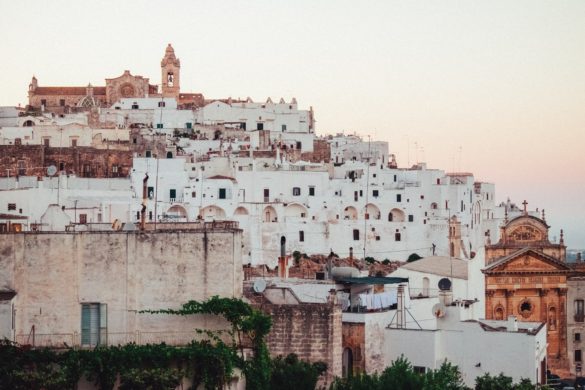
5.  Visit the unique cities of Alberobello – famous for its trullo houses, Ostuni, which is called the ‘white city’ and is reminiscent of Greece, and Lecce, a romantic Baroque city – dubbed the Florence of the South.

6.  If churches are your thing – similarly to the spots in the North, Puglia is littered with them.  Each one more beautiful than the next.

7.  Spa-lovers can experience one of the best thermal spas, perched atop white craggy cliffs along the coast or opt for a more modern, luxurious experience at one of the more upscale hotels in the area where their exclusive products and wellness treatments revolve around local traditions.

8.  Sports enthusiasts and adventure travelers can find fun too.  There are many lovely golf-courses in the region and Puglia is very popular with cyclists as well.

trulli houses in alberobello

The Trulli in Alberobello seem straight out of a fairytale

Why Should you Travel to Puglia?

1.  Because of the delicious food and wine available. In fact, Puglia’s cuisine, a fine example of the Mediterranean diet, is on the UNESCO World Heritage site.  And they have over 26 DOC wines and some of the best extra-virgin olive oil money can buy!   Pretty impressive, eh?  Are you seeing a pattern here yet?

2.  Because Puglia is a very affordable, budget-friendly destination.

3.  Because with two airports, both the Bari airport and Brindisi airport, it’s a very easy area to get to.

4.  Because it’s accessible by train. Although it is always best to rent a car for the most freedom and flexibility, you can actually experience much of Puglia by train. And the possibility of a private driver and/or guide for one day to visit a harder to reach area is definitely an option.

5.  Because the Puglia region has 3 different UNESCO World Heritage sites to explore.  The Trulli, Castel del Monte and the Sanctuary of Archangel Michael in Monte Sant’Angelo.  The Sassi of Matera in nearby Basilicata is also on the list.

6.  Because of the people.  Warm, friendly, welcoming and very willing to please and share their region with you.

Bari port

Bari, capital of Puglia, has a lovely seaport

When Should You Travel to Puglia?

Well, of course my answer would be now! And that’s not just my travel-consultant-self-trying-to-sell-you-a-trip voice talking.  There is a much bigger reason why I say to go to Puglia now.

Right now, the Puglia region is an undiscovered gem.  Sure, it’s been a pretty well-known summer vacation spot for both Italians and Europeans for quite sometime.  But many Americans haven’t really ventured south of Rome (with the exception of Sicily and the Amalfi coast) to discover the treasures of Puglia, yet.

But that is about to change in a very big way, I can promise you that.  In fact, I know of at least five recent conferences/events that have taken place over the past few months- all in an effort to heavily promote Puglia tourism. The push is on.

And you know what will happen when word starts getting out, right?  Massive amounts of tourists.  And more tourists means a lot less availability, which will cause prices to increase and it will become harder and harder to find authentic, unspoiled gems in the region.  Dare I say that Puglia might just be the new Tuscany in the next few years?

Another answer to the when to travel to Puglia question would be anytime.  You can travel to Puglia year-round because of its temperate climate. In fact, the region is pretty dry.  So, if you are looking strictly for a beach or seaside destination, May – October is the best time for you.

However, if you are more interested in the scenery, culture, food, wine and history  - Puglia makes a fabulous off-season destination. The weather during my mid-November trip was sunny and warm, in the high 50′s to low 60′s during the day.  The bonuses of an off-season trip are lower prices from November – April, and not competing with many other tourists.

That also translates into a much more authentic visit.

So, what are you waiting for?  If you want to experience Puglia, get in touch so we can discuss how I can best help!

I’m Off to Puglia

I am very excited to report that in just a few days I will be traveling to Puglia!  I’ve never been to this region of southern Italy, the heel of the boot to be exact, so it will be fun getting to explore a new area – an area completely different from the other parts of Italy that I have visited and fallen in love with.

I’ve been as far south as the Amalfi Coast, and have sung many praises about Positano and Ravello – but I’ve never been to the heel of the boot.

If all goes well, I’ll be adding Puglia, also known as Apulia, to the areas that I create custom itineraries, itinerary reviews, provide hourly consults and arrange foodie adventures for.  I’ll also be canvasing the area for yummy cooking classes, wine tastings, market tours and local guides.

What am I most exited about? Why am I looking forward to going?  I’m glad you asked. Let me tell you:

1. Puglia’s food, olive oil and wine. The Puglia region is known as a food-lover’s paradise.  This area produces over 26 DOC  wines, 40% of Italy’s olive oil and hefty amounts of pasta.  Those are promising statistics for a passionate foodie like me. Red wines like Negroamaro and Primitivo will be on my list to sample.  Also on offer will be regional specialties like orecchiette, burrata, focaccia and maybe some fresh local seafood, right off the docks.

I’m drooling just thinking about it – are you?   And though it’s not a look that would blend with the locals, I’m thinking elastic waist pants will be in order.

2.  Puglia is an off-the-beaten-path location. It’s certainly not the first place people think of when planning a visit to Italy – and that gets me really excited.

Trani in Puglia Italy

3. Puglia’s Climate. Because of Puglia’s southern location, the area enjoys a temperate climate year round.  Many of its popular villages, cities and towns are located right on the Adriatic sea, which means beaches, seafood, port towns, azure water, lovely views and of course lots and lots of beautiful photos.

4. Puglia’s UNESCO world heritage sites. At least three of them and I am excited to explore a few of them.

5. The Trulli. Puglia is home to the town of Alberobello, famous for its white limestone houses with conical-shaped roofs, called Trulli - and I’m looking forward to seeing them up close and learning more about them.  The architecture and scenery in this region are all very different from areas like Tuscany.

Alberobello Trullo in Puglia

I’ll have lots to write about when I return, but if you can’t wait for my updates on the blog, feel free to follow along on Twitter and Facebook as I will be sending out updates about my discoveries, what I’m eating and of course lots of photos during my time in Puglia!

Photo Credit : Flickr

Venice’s New Hotel Tax : An Overview and Tips for Paying Less of It

Grand Canal in Venice Italy

Earlier this year both Florence and Rome implemented a new hotel tax and now Venice is jumping on the bandwagon.  Or should I say, jumping on the gondola?!  Venice’s hotel tax which started on August 24th, may dissuade would-be visitors from setting foot in this already expensive Italian city. Many repeat visitors who’ve already visited Venice once may decide to steer clear, but for first-time visitors, I would still highly recommend you visit.

Since the specifics are lengthy, complicated, and require an accounting degree to decipher, I’ll give you a general overview of the tax, give you a few tips on how to avoid paying top dollar for your overnight accommodation in Venice and provide you with links to the detailed info.

Quick Overview of Venice’s Hotel Tax

  • The hotel tax is similar to those in Rome and Florence in that the tax is based on a sliding scale of the hotel’s rating. So, generally speaking, a 1-star hotel in high-season in the historic center carries a 1€ fee, a 2-star carries a 2€ fee, and so on, all the way up to five stars.
  • B&B’s, apartment rentals, room rentals, guest houses, campgrounds (yes, there are a few in Venice) and monasteries each have their own tax rate, which are a different rate than hotels.
  • All tax rates, no matter what type of accommodation, vary by location.  There are three separate location categories.  Staying in Venice’s historical center garners the highest taxes, followed by the Islands (Lido, Murano, Burano).  Staying on the mainland offers the lowest tax rate.
  • Taxes are calculated per person, per night.
  • Taxes will be collected on stays of up to five consecutive nights.  So nights six and beyond are free – bonus!
  • A visit in high-season will be taxed more than in low-season.  High-season is generally considered the periods surrounding major holidays, ie – the new year, Carnivale, Easter, Christmas – and the busy months from April through the end of October.
  • Children under 10 are exempt.  Children up to the age of 16 will pay half.
  • Hostels are exempt.

Red Building in Venice

Tips for Avoiding or Paying Less of a Hotel Tax in Venice

  • To avoid paying the hotel tax in Venice, consider staying in a hostel, since these are totally exempt from the tax.
  • If hotels are more your bag, opt for a nice 2-star hotel instead of a five-star. The additional tax on a five night stay in a 2-star for 2 people would be 20€.  The same scenario in a 5-star hotel will levy an additional 50€, so you can see how the cost can add up quickly.
  • Travel in low season.  This will not only offer you the best rates, better availability and less tourists, but it will also garner you a lower tax rate. The months of March and November seem to qualify.

Two Tempting (but not recommended) Options

  • Though staying on the mainland or the other islands will offer the cheapest tax rate, I caution you against this, especially with limited time or on a first-time visit. You need to weigh the time and cost associated with traveling back and forth to Venice.  Personally, I would always pay a bit extra to stay right in Venice proper.  For me, an extra euro or so per day, is totally worth the convenience of strolling right outside my door and being able to get around, any time of day or night.
  • You could take a day trip to Venice and avoid paying the overnight tax (rumor has it that Venice is also considering taxing day-trippers), but being that Venice is such a special place, meant to be savored at a slow pace, I don’t recommend it.  I’d much rather see you pony up a few extra pennies to spend at least one night.

I suggest  you check directly with your accommodations when booking to get the skinny on exactly how much you should expect to pay.  You can also consult the City of Venice Tourism website, which offers specific information on the tax rates, specific dates for high and low season and location breakdown.

Ready to plan that dream trip to Venice?  You might be interested in one of these Venice tours.

Italy Travel News : June 2011

In order to keep you in the loop, from time to time, as stories about Italy pop up that relate to travel,tourism and food, I’ll be sharing them with you. Here is some recent Italy travel news for June.

MuranoPhoto Credit : Maurice

  • Murano Wants to Attract More Than Day-Trippers

This tiny island, off the coast of Venice, will forever be known as the destination for glass-making.  But this sleepy enclave is trying to think far into the future when it comes to attracting visitors for years to come.  Murano is planning to build new hotels, expand its urban developement and possibly add an underwater subway which would connect the airport to Murano and Venice, providing rapid transport to and from the island.  This in all in hopes of luring travelers to stay on the island, as opposed to day-tripping in from Venice.  Let’s hope these efforts don’t cause Murano to lose its alluring charm.

  • New Hotel Tax for Florence & Venice

Unfortunately, Florence and Venice have both decided to hop on the same bandwagon as Rome by adopting the same hotel tax in the city that Rome put into place at the beginning of this year. Beginning July 1, 2011, visitors to both locations should expect to pay an additional €1, per person, per night, which will be tacked onto their hotel bill.  I would encourage you to email your hotel directly to double-check what the exact fee will be for your party, as I have seen conflicting reports on how these fees will actually be calculated.

  • Walking in Florence Gets Safer

Though it is difficult to drive in the city center, and I discourage anyone from doing it – not only because it isn’t necessary, but because you’ll likely wind up with a pile of traffic tickets when you return home from vacation.  Florence has decided to implement a few new traffic-free, pedestrian-friendly zones. This is excellent news for travelers walking and touring around the city.  Now you’ll be able to experience the museum of life in these areas a little quieter and safer.  But, you still need to watch for scooters zooming by you at record speeds, practically running you over while YOU are in the cross-walk.  No improvement on that front quite yet!

  • Milan’s La Scala Gets a Bail Out

You may remember luxury shoe giant Tod’s pledged big-time funds to restore and repair the Colosseum in Rome.  Well, now he is also coming through for Milan’s La Scala opera house. According to Reuters, he is donating 5.2 million euros to save the famous failing opera house and is calling on other Italian businessmen to help save Italian cultural treasures. Why not support the cause by purchasing tickets to a show on your next visit to Milan?

Planning a trip to Italy? Click here to see the many ways I can help!

Not Your Everyday Italy Guidebook

Rome Travel Guide Photo: fotologic

Anyone who has ever planned a trip to Italy on their own, or anywhere really,  is very familiar with the big names in travel guides.  Frommer’s, Fodor’s, Lonely Planet, Rick Steves and DK Eyewitness Travel Guides all top the list.

And while all of those guides are well-respected and serve a very specific, important purpose, I just love to shout from the Italian terracotta rooftops when I come across a unique travel guide about Italy.

When someone takes a creative approach to a place as written about as Italy and puts a different spin on it, looks at it through a different lens and then writes about something that appeals to a specific type of traveler, I like to talk about it.  Reading an Italy travel guide with a quirky theme or a unique angle really gets me excited, especially when a learn something new at almost every page turn.  It renews my passion for the Bel Paese.

Today, I thought I would share some that speak to me personally, which is why I have recommended them.

1.  100 Places in Italy Every Woman Should Go. Susan Van Allen has created a delicious list of some fabulous places that travelers headed to Italy should experience.  From spas to shopping, ceramics to churches and everything in between.  And though the title speaks to females, perhaps for marketing reasons, there should be no reason that men wouldn’t enjoy most of the suggested items.

2.  Italy for the Gourmet Traveler. More than a travel guide, this is a giant bible that should be on every food-worshiping Italophiles’ nightstand. Fred Plotkin is *the* ultimate Italian food foodie and his book focuses on, you guessed it, food.  But not just the typical restaurant recommendations for the largest cities.  Instead he aims to educate the reader on food, wine, recipes, customs and cultural traditions throughout more than 500 cities and all 20 regions of Italy.  A favorite for getting off-the-beaten-path.

3.  Made in Italy. This Italy guidebook is a shopper’s dream. It’s a perfect resource for those who wish to shop, experience or just browse through artisan shops and boutiques while traveling throughout Italy. The guidebook focuses on the artisanal traditions that Italy is famous for – jewelry, leather, ceramics, Murano glass and of course, food and liqueurs.

4.  The Romantic’s Guide to Italy. No  doubt about it, Italy is one of the world’s most romantic destinations.  For those who want to have a love affair with Italy, get married or honeymoon in Italy or just spend time in some of those most charming and idyllic spots, this is the Italy guidebook for you!

5. Italy : Instructions for Use. Perhaps my favorite Italy guidebook isn’t packed with local addresses, restaurant and hotel suggestions or drop-dead gorgeous photos.  Instead it has what travelers to Italy need most – practical advice.  Tips on using Italy’s transport systems, the language, store and restaurant hours, cultural notes and more. It’s how to do Italy right.  Don’t leave home without it!

Traveling to Italy? Click here to see how I can help plan your dream trip!

Travel Tip Tuesday : Italian Language Basics to Learn for Travel

Travel Tip Tuesday LogoThere are those of you who love learning a new language, and those who don’t.  Many travelers heading to Italy have no desire to learn the language and think everyone will just speak English anyway, so what’s the point.

Personally, I am in the first camp, especially when it comes to learning Italian.  It’s just one of the most beautiful and melodic languages out there – I relish the opportunity to use it and learn more of it.

But I certainly understand those who don’t have the time or desire to tackle a new language.  But, I still think learning some beneficial Italian language phrases before traveling to Italy, is a good idea.  Here’s what I recommend:

1.  Learn Italian pleasantries. Yes (si) and No (no) are easy.  Hello and Goodbye (ciao), Please (per favore), Thank You (grazie) and You’re Welcome (prego) all go a long way and should be used often.  Basic Italian greetings like good day (buongiorno) and good night (buona notte) sound lovely and will come in handy.

2.  Learn how to ask questions. Who (Chi) , What (Che), Where (Dove), When (Quando) and How (Come).  My biggest recommendation of the bunch is where or dove, pronounced doh-vey. It is an invaluable Italian word for travel.  Very useful when you need directions, a bathroom, a specific restaurant, the post office or a museum. Commit Dov’é il gabinetto to memory. It means ‘where is the bathroom’?

3.  Learn the days of the week, numbers 1-10 and how to tell time.  These things will be very helpful when reading a train ticket, metro or bus schedule, as well as opening and closing hours for restaurants and museums.  It is important to know that Italy generally follows military time.

4.  Learn how to ask if  someone speaks English. Sure, if you ask them in English and they do speak English, they will most likely answer you back.  But asking in Italian is just more respectful.  Locals will like the fact that you are at least making an attempt to speak a little of their language and they may be more helpful.  Just ask “mi scusi, parla Inglese?”  Conversely, learn how to tell someone you don’t speak Italian by saying “Mi dispiace, non parlo Italiano.”

If you wish to learn some Italian language basics, and pronunciations, here are a few related links that might help:

Don’t forget to see what travel tips Cherrye has today!

Traveling to Italy? Click here to see how I can help!


Ten Things I Love About Ravello

Photo Credit : Flickr

I dare anyone to find a town along the Amalfi Coast that isn’t worth a visit.  Each and every one of them has their own charm, hidden-gems and things that makes them special.

One of the loveliest and quiant towns, perched atop a cliff, high above the coast, is Ravello.  And here are ten of the things I love most about Ravello.

1.  The views. The fact that Ravello lies up in the hills above the coast, means it offers a fantastic vantage point from which to see both up and down the rocky coastline. No matter where you roam, you’ll be rewarded with breathtaking vistas and a different panorama at every turn.

2.  Villa Rufolo.  Named for the family who created it, the Villa Rufolo is an eclectic mix of  Arabic, Sicilian and Norman architecture.  Medieval towers, two-tiered Moorish cloisters and 19th century gardens combine in a beautiful setting.  Inspired by the gardens, composer Richard Wagner used them for the setting for his opera Parsifal.

3.  Villa Cimbrone. The stunning Italian and English-style gardens on the grounds of the Villa Cimbrone are the star of the show here.  There are many different landscaped areas, but the most noteworthy spot is the Infinity Terrace, which is lined with marble busts.  From this platform, you feel like your suspended in mid-air as you take in the views and feel swallowed up by the blue sea below and sky above.

4.  A meal at the Villa Maria.  The Villa Maria is a charming hotel in a prime location, situated at the end of a small cobbled pathway.  The restaurant’s food is fresh and top-notch, but enjoying lunch or dinner on the outside terrace is enchanting, especially if you score a table near the railing which overlooks the Dragone Valley and the coast.

5.  The Duomo.  Built in 1087, this simple church with the white facade has a wonderful set of bronze doors, that are made up of 54 different panels.  The interior boasts intricate white marble designs and busts, mosaics and medieval frescoes and pulpits. The lovely bell tower just adds to the charm.

6.  The lemons.  Lemons the color of sunshine itself and the size of softballs perfume the whole town as they dangle from graceful branches of lemon trees in gardens, terraces and hotel grounds all over town.  Trust me, you’ve never seen such large lemons!

7.  Limoncello. Even though lemons are used to make the addictive and refreshing smooth, yet tangy liqueur, I felt it really deserved its very own mention. Though other areas on the Amalfi Coast make limoncello, some of the best is made in Ravello.  Watch how to make it, and enjoy a nice tasting at the Limoncello Factory at Via Trinity, 37.

8.  Ceramics. I’m a sucker for colorful handmade Italian ceramics in vibrant colors like teal green, royal blue, and bright yellow.  Thankfully Ravello has no shortage of places to admire or purchase pottery.  The Ceramiche d’Art Pascal and Ceramiche Da Lena are two well-known options that have been staples for quite sometime.  I love to wander the streets looking for the colorful platters, in many patterns that hang precariously over the ceramic shop doorways while larger pieces spill out onto the streets.

9.  The outdoor concerts. Ravello hosts an outdoor concert series every summer, courtesy of the Ravello Concert Society. Lovely classical music and piano concerts are held outdoors in the romantically lit gardens on the grounds of the Villa Rufolo.  As an added bonus, they serve limoncello at intermission. It makes for  a magical evening.

10.  The churches. Considering the tiny size of this sleepy town, it is surprising that it has so many churches.  Other than the Duomo, the town has seven other churches, all within easy walking distance.  They are all worth a visit, but some notable favorites are the Church of San Francesco, Santa Maria a Gradillo and the San Giovanni del Toro.

What is your favorite thing about Ravello?